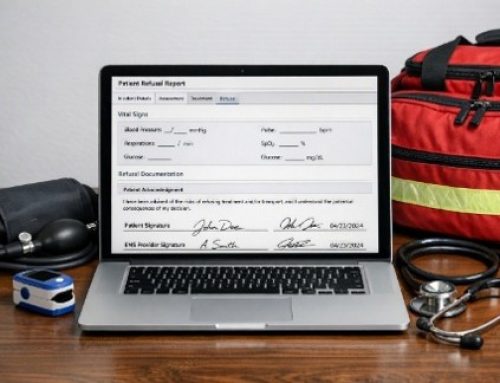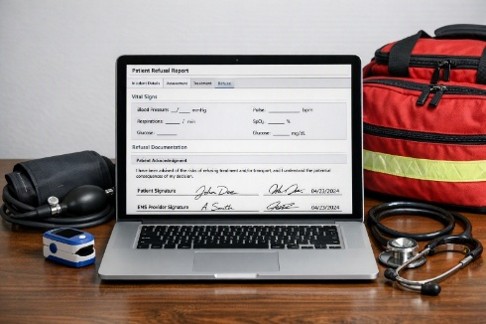

The Most Preventable Dangerous Call in EMS?
This article is the seventh and final installment in a 7-part series on EMS patient refusal implementation and documentation. Each article examines one specific area of refusal documentation and how to best execute a patient refusal and document the interaction in a legally defensible manner.
Part 7. Lift Assists: The Missed Patient Refusal
By Paul Girard & Kevin Kelley
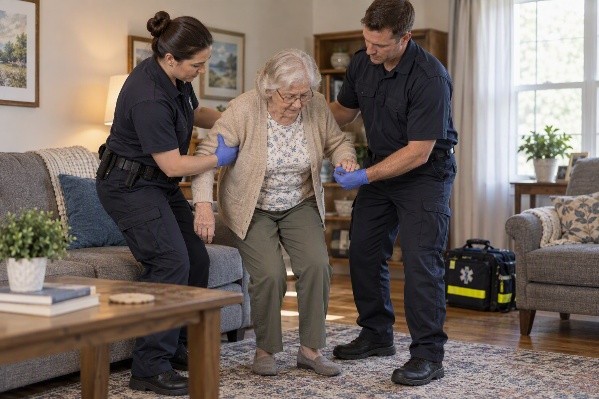
Lift assist calls are often treated as customer service calls, public assists, or quick resets. Crews arrive, help someone off the floor, collect a signature if required, and clear. That approach may feel efficient, but it misses the central risk: if EMS evaluates a person after a fall, weakness, dizziness, illness, injury, or functional decline, and that person does not go to the hospital, the encounter is a patient refusal.
This final article in the series focuses on why lift assist calls should be managed as refusals, what crews need to assess before leaving, and how the documentation should show that the patient made an informed decision after an appropriate EMS evaluation.
Without a doubt this aspect of the refusal process is one of the most highly misapplied principles. We routinely see refusal reports where both competency and capacity are inadequately addressed. In fact, it is not uncommon for us to review refusal reports where patients are intoxicated, altered, or have other conditions that would completely undermine the defense that the patient was able to sign the refusal. We have even seen minors signing refusal forms without any discussion as to whether the patient was emancipated or otherwise legally capable.
A signed refusal form does not make an invalid refusal valid. The provider must be able to show that the patient was legally able to make the decision and clinically capable of understanding the consequences of that decision at the time the refusal was executed.
The Problem With “Just a Lift Assist”
The phrase “lift assist” can unintentionally minimize the call. It suggests the patient simply needed help standing up and nothing more. In reality, the reason the patient is on the floor may be clinically important. A fall may be caused by syncope, stroke, sepsis, hypoglycemia, medication effects, dehydration, arrhythmia, intoxication, trauma, or a worsening chronic condition. Even when the patient insists that they are fine, EMS still has to determine whether the person has decision-making capacity, understands the risks, and is refusing further care or transport. All of that activity needs to be documented in case questions arise in the future.
A lift assist without an assessment is not a low-acuity call; it is incomplete patient contact.
Why Lift Assists Become Refusals
Once EMS makes patient contact and there is a potential medical or traumatic complaint, the patient must either be transported, released to another appropriate level of care, or refuse recommended evaluation or transport. Lift assist calls commonly fall into the refusal category because the patient declines transport after EMS has been called for a condition involving potential injury, illness, or inability to move independently.
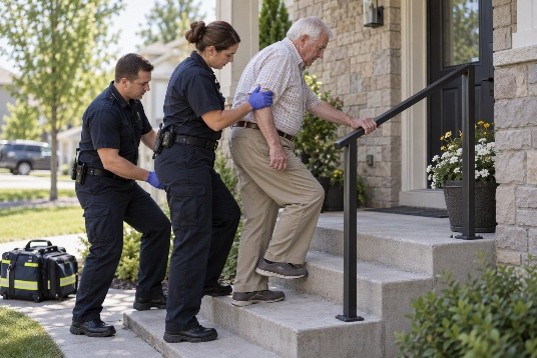
Many lift assists seem innocuous at first. The patient or family member may have called simply to get assistance without realizing there is a medical or traumatic issue involved. One common assist scenario is family calling EMS for help in getting a loved one into the house after a day out.
It may seem like they are simply asking for assistance getting up the front stairs, but the EMS crew needs to verify that there is nothing more going on. How did the patient get down the stairs in the first place? WHY can they not get back up them? We often see lift assist calls result in a call back at a later time with an issue that may have been identified on the original call had the crew performed an assessment or asked probing questions that may have uncovered the real reason for the need for assistance.
If the patient cannot climb the 3 stairs to get into the house, it raises several questions as to why. Is the patient too weak? If so why, what are their vitals? What is the patient’s blood glucose reading? What does a 12 lead show? What is the patients’ overall neurological assessment like? Any of these assessment points may reveal a clinical issue that is manifesting itself and needs to be identified for the sake of the patient’s health.
In one case we reviewed, the patient could not get up the stairs as she had fallen several days prior and was having mobility limitations as a result of a hip fracture. The providers wisely did not get fooled into simply helping the patient get up the stairs and leaving the patient home. As a result of their assessment, they correctly suspected the patient’s lack of mobility could be from a hip injury, and they were correct! Nice pickup on their part.
The crew’s responsibility is not limited to lifting. The crew must identify what happened, assess for time-sensitive problems, explain the risks of refusing further care, offer transport or appropriate alternatives, and document the patient’s informed decision. Helping a patient get back into bed only to get called back later when the patient is unable to get back out of the bed on their own is an EMS miss.
The Minimum Assessment Before Leaving
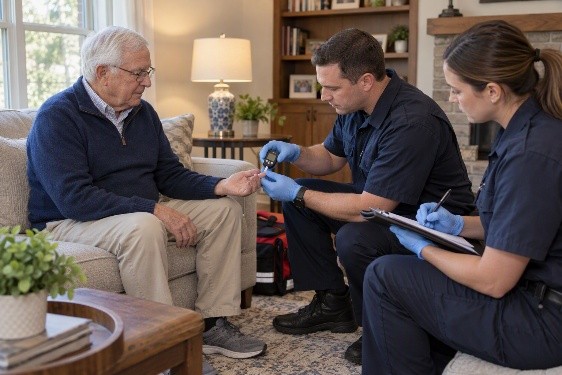
Before a lift assist is completed as a refusal, crews should document at least the basics of a focused evaluation. That includes the patient’s mental status, orientation, capacity, chief complaint or denial of complaint, mechanism of fall or reason for being on the floor, pertinent negatives, vital signs, assessment findings, ability to ambulate or return to baseline, and any concerning environmental or social factors.
- Why was EMS called?
- How did the patient get to the floor?
- Was there a fall, syncope, dizziness, weakness, altered mental status, pain, illness, or injury?
- Did the patient strike their head, lose consciousness, take anticoagulants, or have new neurologic symptoms?
- Are vital signs within a reasonable range for that patient?
- Can the patient make an informed decision and communicate a consistent choice?
- Can the patient safely remain where they are with available support?
If the answer to any of these questions is uncertain, the call should not be treated as a quick lift. The uncertainty itself is part of the risk discussion and must be addressed before the crew clears.
The irony of this is in order to prove the patient is truly only a lift assist and has no real injury or illness, a full assessment needs to be done and the results documented to prove you assessed the patient and they actually did not have anything wrong with them. It is a bit of a circular approach, but it is the only way to prove you did all you could to confirm the patient is not compromised in any way. Your PCR is the only proof you have that you did assess the patient and there were no important clinical findings. Without it, if the patient ends up with a bad outcome, it appears the EMS crew missed something and did not do their job properly.
The Refusal Conversation
The refusal conversation should be direct, specific, and documented in plain language. Crews should tell the patient what they are concerned about, what EMS recommends, what could happen if the patient stays home, and that the patient can call back at any time. Generic statements such as “risks explained” or “patient refused” are not enough.
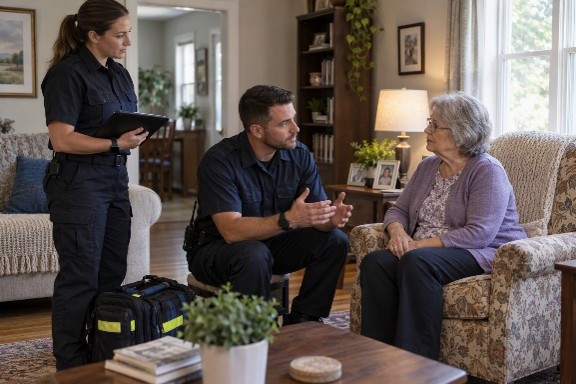
For example: “Because you were unable to get up after falling, we are concerned there may be an injury or medical cause that is not obvious right now. We recommend transport for further evaluation. If you stay home, symptoms could worsen, you could fall again, or a condition such as bleeding, stroke, infection, or heart problem or other condition that cannot be adequately identified in the field could be missed.”
The point is not to frighten the patient. The point is to make sure the patient understands the reasonable risks of declining EMS transport or further evaluation.
Capacity Still Matters
Capacity is not proven by a signature. A patient must be able to understand the information, appreciate the situation and consequences, reason through the options, and communicate a choice. On lift assist calls, capacity can be affected by head injury, hypoxia, hypoglycemia, infection, intoxication, medications, dementia, fatigue, shock, or a simple language barrier. If capacity is questionable, crews should slow down, reassess, involve medical control when appropriate, and follow local policy.
Documentation should show more than “alert and oriented.” It should explain why the crew believed the patient could make the decision, what the patient understood, and how the patient responded to the recommendation for transport.
Documentation That Protects the Patient and the Crew
A strong lift assist refusal narrative should make the call understandable to someone who was not there. It should describe the dispatch information, scene findings, patient position on arrival, patient statements, assessment performed, findings, recommendation, risks explained, patient decision, witnesses or family involvement, and instructions given before clearing.
- Document the reason the patient was on the floor, not just that the crew lifted them.
- Document the patient’s own words when possible.
- Document assessment findings and vital signs, including abnormal findings and pertinent negatives.
- Document the recommendation for transport or further evaluation.
- Document specific risks explained to the patient.
- Document the patient’s capacity and understanding.
- Document who remained with the patient and what return precautions were provided.
Poor Documentation Versus Strong Documentation
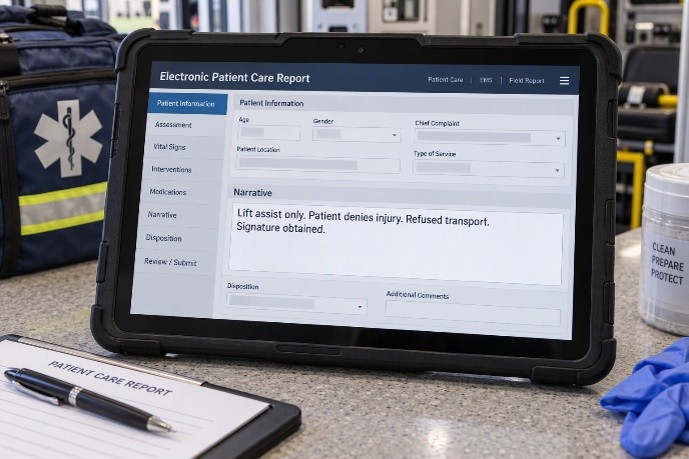
Poor: “Lift assist only. Patient denies injury. Refused transport. Signature obtained.”
Strong: “Dispatched for lift assist. Patient found seated on bedroom floor beside bed. Patient states he slid from bed while attempting to stand and was unable to get up without assistance. Denies head strike, loss of consciousness, neck/back pain, chest pain, shortness of breath, dizziness, weakness, or new pain. Patient alert, oriented, speaking clearly, and able to explain situation and decision. Vital signs assessed. No obvious injury noted on focused assessment. EMS recommended transport for further evaluation due to fall and inability to get up independently. Patient verbalized understanding of risk of hidden injury, recurrent fall, worsening weakness, or medical cause of fall, and declined transport. Patient assisted to chair, stood and ambulated at baseline with walker. Family member remained on scene. Patient instructed to call 911 for pain, dizziness, weakness, confusion, another fall, or any worsening symptoms.”
Common Pitfalls
When documenting a patient refusal, the PCR should clearly address each of the following points:
- Calling it “no patient” when EMS clearly evaluated (or should have evaluated) or assisted a person.
- Documenting only the lift and not the reason the patient needed lifting.
- Skipping vital signs because the patient “only wanted help up.”
- Failing to assess capacity before accepting the refusal.
- Using generic risk language that does not match the actual call.
- Letting family or facility staff refuse on behalf of a capable patient.
- Clearing before confirming the patient can safely remain where they are.
The Takeaway
Lift assist calls are not automatically harmless. They are refusals in disguise. If EMS is called because someone cannot get up, the crew must determine why, assess for injury or illness, explain the risks of declining transport, verify capacity, and document the decision clearly. Treating lift assists as refusals does not make the call more complicated than it needs to be; it makes the interaction complete.
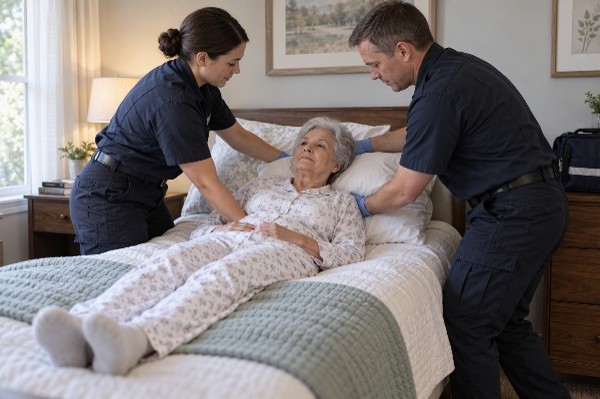
Some states have specific protocol language stating all EMS interactions that do not result in transport are to be treated as a refusal. This means if your agency arrives on scene and puts an elderly patient back in bed and simply writes “lift assist only” on their run report, the crew could be sanctioned for their actions (especially if something bad happens to the patient).
This is not only about properly documenting a lift assist call to “cover” your actions. We are professional EMS providers whose very job is to protect the patient from further harm, even when the patient may not realize they have a clinical problem. Isn’t that why we got into EMS in the first place?
¨¨¨¨¨¨
If your organization needs help with patient refusal documentation, contact us for a quote to create a custom program for you.
You can also check out our introductory article on this topic: Patient Refusals: A Risk to an EMS Providers Life, Liberty, and Pursuit of Happiness
Or Part 1 in the series: Incomplete Patient Assessment
Part 2 in the series: Missing Signatures and Incomplete Refusal Forms
Part 3 in the series: Poorly Explained Risks of Refusing
Part 4 in the series: Failure to Contact Medical Control on High-Risk Refusals
Part 5 in the series: Incomplete or Missing Vital Signs
Part 6 in the series: Verifying Patient Competency and Capacity Before Executing a Refusal
For more information you can visit the Girard & Associates website at www.girardassoc.com or contact Paul Girard at paul.girard@girardassoc.com or Kevin Kelley at kevinkelleylaw@gmail.com.
About the Authors
Paul Girard, a retired paramedic and EMS Director, is the Founder and President/CEO of Girard & Associates, Inc., a national EMS clinical quality improvement consulting firm. He has worked in EMS continuous quality improvement since the mid-1980s and founded Girard & Associates, Inc. in 2005 to help EMS agencies better monitor, evaluate, and improve the patient care they provide. An EMS CQI entrepreneur, Paul invented and utilizes a proprietary scoring and rating system that drives a teaching, coaching, and mentoring-based CQI process, supporting providers in strengthening clinical judgment, documentation quality, and professional performance. The firm delivers CQI auditing, program development, and CQI program administration for EMS agencies nationwide. Paul is also the co-host of “The G&A Way EMS CQI” podcast.
Kevin J. Kelley, Esq. began his EMS career in 1986. A retired paramedic and EMS Director turned attorney in 2004, Kevin is the founder of Rescuing Rescuers, PLLC, a Massachusetts law firm dedicated to representing firefighters, EMTs, paramedics, and other licensed healthcare professionals. His practice focuses on EMS license regulatory defense, on- and off-duty criminal and self-defense matters, clinical documentation risk assessment, and firehouse EMS-focused education designed to strengthen patient safety, provider decision-making, and professional defensibility before DPH/OEMS, Division of Administrative Law Appeals, and civil and criminal courts. Kevin is also the co-host of “The G&A Way EMS CQI” podcast.