
The Most Preventable Dangerous Call in EMS?
This article is the sixth installment in a 7-part series on EMS patient refusal implementation and documentation. Each article examines one specific area of refusal documentation and how to best execute a patient refusal and document the interaction in a legally defensible manner.
Part 6. Verifying Patient Competency and Capacity Before Executing a Refusal
By Paul Girard & Kevin Kelley
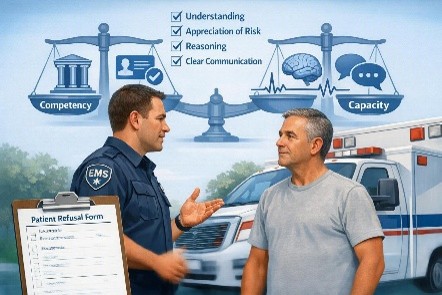
In part 6, we review one of the most important questions in every refusal encounter: did the patient have the legal competency and medical decision-making capacity required to refuse care, treatment, or transport?
Without a doubt this aspect of the refusal process is one of the most highly misapplied principles. We routinely see refusal reports where both competency and capacity are inadequately addressed. In fact, it is not uncommon for us to review refusal reports where patients are intoxicated, altered, or have other conditions that would completely undermine the defense that the patient was able to sign the refusal. We have even seen minors signing refusal forms without any discussion as to whether the patient was emancipated or otherwise legally capable.
A signed refusal form does not make an invalid refusal valid. The provider must be able to show that the patient was legally able to make the decision and clinically capable of understanding the consequences of that decision at the time the refusal was executed.
Why Competency and Capacity Matter
Patient refusal calls are dangerous because they often look routine until the outcome turns serious. The patient is awake, talking, and insisting they do not want help. The crew may feel pressured to clear the call. But when that patient later deteriorates, the refusal documentation will be examined to determine whether the patient had the ability to refuse in the first place.
The distinction is critical: competence is generally a legal determination, while capacity is a clinical assessment made at the time of the encounter. EMS providers usually do not declare a person legally competent in the broad sense. Instead, they document the facts showing the patient had—or did not have—the present ability to make the specific medical decision being presented.
The Baseline Question: Can This Patient Refuse?

Before accepting a refusal, the provider should answer three practical questions. First, is the patient legally permitted to refuse? Second, does the patient appear free from medical, traumatic, toxicologic, or psychiatric conditions that impair judgment? Third, can the patient understand, appreciate, reason through, and communicate a decision about the risks of refusing care?
Orientation alone is not enough. Writing “alert and oriented x4” may describe part of the mental status assessment, but it does not, by itself, prove capacity. A defensible refusal narrative should show how the provider reached the conclusion that the patient could understand the situation, weigh the risks, and make a voluntary decision. Just because the patient can recite what you told them back to you also does not mean they understood the implications of those statements. It is incumbent upon the provider to show that the patient understood the discussion.
Elements of a Capacity Assessment
A useful refusal narrative should document that the patient was able to do the following:
- Communicate a clear choice: The patient can state what they are refusing and does not fluctuate between conflicting decisions without explanation.
- Understand the information provided: The patient can repeat or explain the provider’s concerns, assessment findings, and recommendation for treatment or transport. It is best if the patient can repeat the conversation in their own words and explain back to you what they understood the conversation to be about.
- Appreciate personal risk: The patient recognizes that the risks apply to them, not just to patients in general.
- Reason through the decision: The patient can explain why they are declining care and how they weighed the risks, benefits, and alternatives.
The provider should also document the absence—or presence—of factors that may impair decision-making, including suspected intoxication, hypoxia, hypoglycemia, head injury, altered mental status, severe pain, shock, psychiatric crisis, language barriers, or coercion by another person at the scene.
Competency Is Not a Checkbox
Many refusal forms ask whether the patient is “competent.” That does not mean the provider should simply check a box and move on. If the patient is an adult and there is no obvious legal barrier to refusal, the more important field assessment is whether the patient has current decision-making capacity. If the patient is a minor, under guardianship, subject to a court order, or otherwise unable to make legal decisions, the provider must follow local law, agency policy, and medical control direction.
Documentation should avoid conclusory language. Instead of writing only, “Patient competent to refuse,” the PCR should include the observations and patient statements that support that conclusion. The record should make it clear that the patient was assessed, questioned, informed, and able to demonstrate understanding.
What Strong Documentation Looks Like
A strong refusal narrative connects the patient’s condition, the provider’s assessment, the capacity determination, the risks explained, and the patient’s final decision. The goal is not to write a legal brief. The goal is to create a clear, factual record that shows the refusal was informed and valid.
Example: “Patient awake, calm, and oriented to person, place, time, and event. Speech clear. No odor of alcohol noted. Gait steady. BGL 118 mg/dL. SpO2 98% on room air. Patient able to explain that EMS was concerned about possible cardiac cause of symptoms and that refusal of transport could result in worsening condition, loss of consciousness, permanent injury, or death. Patient stated, ‘I understand you think this could be serious, but I do not want to go to the hospital. I will call my doctor and have my wife stay with me.’ Patient repeated return precautions and agreed to call 911 if symptoms returned or worsened.”
It is also good to document patient statements that may appear minor but can demonstrate understanding. For example, if the patient states they understand they may be having a cardiac condition as their father had a similar episode that turned out to be cardiac many years ago, that may help to show the patient understood more thoroughly than simply stating “the patient understands and is still refusing transport”.
We often hear providers tell us that there was much more discussion on scene about the refusal process that never made it to the PCR because the provider felt some of the statements were not necessary to document.
Any verbal, and on occasion, non-verbal queues that imply understanding should be documented. One provider described on her PCR that when she mentioned the patient could die from their medical condition, the patient visible appeared distressed and appeared more apprehensive and nervous throughout the rest of the interaction. While this may not in and of itself prove understanding, it does give the reader a clearer picture of how the interaction went and the level of concern of the patient after those statements were made. The medical director when reviewing the call felt that the overall picture painted by the medic in her documentation including that phrasing, was enough to show the patient clearly understood the implications of refusing.
This type of documentation does more than say the patient had capacity. It shows the facts that allowed the provider to reasonably conclude that the patient had capacity.
Red Flags That Should Slow the Refusal Down

Some refusals require additional caution because the capacity assessment is more likely to be challenged later. These include refusals involving chest pain, shortness of breath, syncope, head injury, intoxication, hypoglycemia, stroke-like symptoms, suicidal statements, confusion, elderly or medically fragile patients, and any situation where family members, police, bystanders, or clinicians disagree about whether the patient should be transported.
When those red flags are present, providers should consider additional assessment, involvement of medical control, consultation with supervisors, use of interpreters when needed, and careful documentation of the patient’s answers. If the patient cannot demonstrate understanding or appreciation of the risks, the refusal should not be treated as a valid informed refusal.
Common Documentation Pitfalls
- Documenting only “A/O x4” without describing understanding, appreciation, reasoning, or communication.
- Failing to document possible impairing conditions such as intoxication, head trauma, hypoxia, hypoglycemia, shock, or psychiatric crisis.
- Documenting a language barrier without describing what methods were used to ensure the patient understood the discussion.
- Allowing a family member or bystander to make the refusal decision when the patient’s own capacity has not been assessed.
- Obtaining a signature without documenting the conversation that made the refusal informed.
- Using vague conclusions such as “patient refused all care” without listing what was offered and what was declined.
- Failing to contact medical control or a supervisor when the patient is high risk or capacity is uncertain.
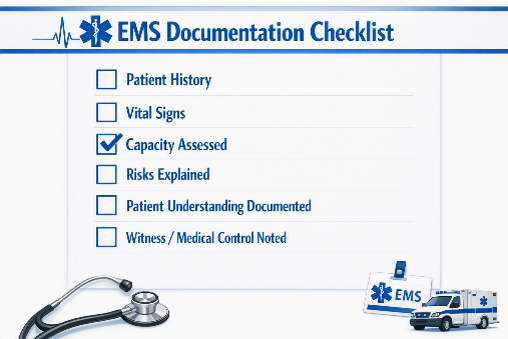
Documentation Checklist
When documenting a patient refusal, the PCR should clearly address each of the following points:
- Patient’s apparent legal ability to refuse, including age, guardianship concerns, or other obvious legal limitations when applicable.
- Mental status findings beyond orientation, including speech, behavior, coherence, and consistency of decision-making.
- Assessment findings relevant to capacity, such as vital signs, blood glucose, oxygenation, trauma findings, intoxication indicators, or other conditions that may impair judgment.
- Evidence that the patient understood the provider’s concerns, recommended treatment or transport, and the risks of refusing.
- Evidence that the patient appreciated that those risks applied personally to them.
- Patient’s stated reason for refusing care, treatment, or transport. Providers should also document if they offered advice or counsel to allay any patient concerns.
- Specific care, treatment, assessment, or transport options offered and specifically refused.
- Alternatives discussed, including contacting a physician, going by private vehicle when appropriate, staying with a responsible adult, or calling 911 if symptoms worsen.
- Use of medical control, supervisory consultation, law enforcement, interpreter services, or witnesses when indicated.
- Return precautions provided and the patient’s acknowledgement of those instructions.
- Names and roles of witnesses, if present, and whether signatures were obtained or refused.
The Bottom Line
Every valid refusal begins with the same threshold question: can this patient legally and clinically refuse? If the answer is yes, the PCR must show why. If the answer is no—or if the provider cannot confidently determine the answer—the call must be managed differently.
Competency and capacity are not paperwork formalities. They are the foundation of the refusal. A refusal form may capture the patient’s signature, but the narrative must capture the patient’s ability to make the decision.
In the final part of this series, we will discuss lift assist and why they are considered the “missing refusal”.
¨¨¨¨¨¨
If your organization needs help with patient refusal documentation, contact us for a quote to create a custom program for you.
You can also check out our introductory article on this topic: Patient Refusals: A Risk to an EMS Providers Life, Liberty, and Pursuit of Happiness
Or Part 1 in the series: Incomplete Patient Assessment
Part 2 in the series: Missing Signatures and Incomplete Refusal Forms
Part 3 in the series: Poorly Explained Risks of Refusing
Part 4 in the series: Failure to Contact Medical Control on High-Risk Refusals
Part 5 in the series: Incomplete or Missing Vital Signs
For more information you can visit the Girard & Associates website at www.girardassoc.com or contact Paul Girard at paul.girard@girardassoc.com or Kevin Kelley at kevinkelleylaw@gmail.com.
About the Authors
Paul Girard, a retired paramedic and EMS Director, is the Founder and President/CEO of Girard & Associates, Inc., a national EMS clinical quality improvement consulting firm. He has worked in EMS continuous quality improvement since the mid-1980s and founded Girard & Associates, Inc. in 2005 to help EMS agencies better monitor, evaluate, and improve the patient care they provide. An EMS CQI entrepreneur, Paul invented and utilizes a proprietary scoring and rating system that drives a teaching, coaching, and mentoring-based CQI process, supporting providers in strengthening clinical judgment, documentation quality, and professional performance. The firm delivers CQI auditing, program development, and CQI program administration for EMS agencies nationwide. Paul is also the co-host of “The G&A Way EMS CQI” podcast.
Kevin J. Kelley, Esq. began his EMS career in 1986. A retired paramedic and EMS Director turned attorney in 2004, Kevin is the founder of Rescuing Rescuers, PLLC, a Massachusetts law firm dedicated to representing firefighters, EMTs, paramedics, and other licensed healthcare professionals. His practice focuses on EMS license regulatory defense, on- and off-duty criminal and self-defense matters, clinical documentation risk assessment, and firehouse EMS-focused education designed to strengthen patient safety, provider decision-making, and professional defensibility before DPH/OEMS, Division of Administrative Law Appeals, and civil and criminal courts. Kevin is also the co-host of “The G&A Way EMS CQI” podcast.