
The Most Preventable Dangerous Call in EMS?
This article is the 2nd installment in a 7-part series on EMS patient refusal implementation and documentation. Each article will take a look at one specific area of refusal documentation and how to best execute a patient refusal and document the interaction in a legally defensible manner.
Part 2. Missing Signatures and Incomplete Refusal Forms
By Paul Girard & Kevin Kelley

There is a persistent belief in EMS that if the patient signs the refusal form, the case is defensible.
That belief is wrong.
A signature does not establish capacity. It does not prove that risks were explained. It does not show that an assessment was performed. It does not confirm that the refusal was informed. It is one piece of documentation, and without a complete narrative and proper process behind it, it carries limited weight.
However, when signatures are missing, incomplete, or later questioned, the entire refusal becomes vulnerable.
In Massachusetts, refusal documentation is evidence. If a patient deteriorates or dies, that documentation will be examined carefully.
What a Signature Does and Does Not Do
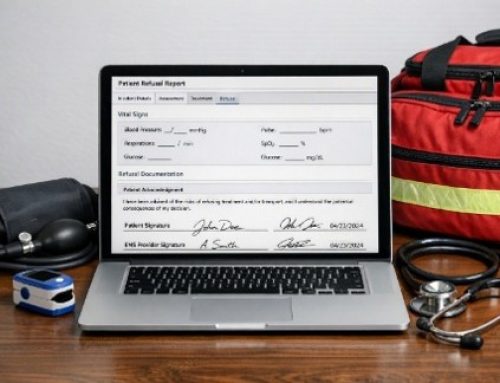
A patient signature confirms that, at that moment, the patient acknowledged declining care or transport.
It does not replace:
- A complete assessment
- A capacity evaluation
- An explanation of risks specific to the patient’s condition
- Documentation of alternatives
- Medical control consultation when appropriate
A signed refusal form with a weak narrative is still weak. A refusal with no signature at all invites even greater scrutiny.
Most protocols require the need to obtain various signatures as they relate to patient refusal documentation. Most everyone is aware that a patient signature is required but many providers also believe that the witness signature and online medical command signatures are optional. In fact, many protocols require a witness signature or documentation that a witness signature was not available to be obtained.
The Witness Signature Issue
Best practice includes obtaining a witness signature whenever possible. The purpose is simple. A witness confirms that the refusal discussion occurred and that the patient voluntarily declined care.
In audits we routinely see:
- No witness signature
- An illegible signature with no printed name
- No documentation of who was present in the narrative
In one data sample a review of 5000 patient refusals showed 86% of the reports were missing either a signature or documentation that a signature could not be obtained.
If a refusal is later challenged, the question becomes: Who observed this conversation?
If the record does not clearly answer that question, credibility becomes the issue.
Why a Witness Signature is Important
Many providers believe that a witness signature is one of the less important items on the refusal documentation checklist. It isn’t!
A witness signature can do several things for you to lend credibility to your actions.
- Obtaining a witness signature implies the providers made valid attempts to convince the patient to be seen at the hospital (assuming providers made valid attempts).
- It provides a witness to the events of the interaction that can bolster the credibility of the providers when they are trying to defend themselves against accusations later.
- It can validate to what degree providers assessed, treated, and tried to convince the patient to be seen at the hospital.
- If the witness is an objective observer, they can rebut claims made by parties who are partial to the complaining party.
It may prevent a witness who signed the refusal from later making claims that are not supported by evidence that is well documented in the report.
When Documentation Becomes the Case
A recent Michigan appellate decision illustrates how refusal documentation can shift the entire focus of litigation.
In Wehner v. Tri-Hospital EMS (October 2025), arising from events in 2023, a 57-year-old man who was COVID positive died at home after EMS responded three times over a five-day period and did not transport him. Paramedics documented refusals indicating that the patient declined care.
After his death, his wife told a 911 dispatcher, “They kept leaving him here.”
The lawsuit alleged that EMS personnel discouraged transport by stating that hospitals were full. It further alleged that refusal signatures were falsified or completed after the calls, with time stamps reflecting post run documentation. A handwriting expert later opined that the signatures on the refusal forms were not written by the patient.
The appellate court did not determine liability. Instead, it addressed whether the case should have been dismissed at summary judgment. The court held that qualified immunity protects EMS providers from claims of ordinary negligence but does not apply to conduct that could constitute gross negligence. The court found that the record contained evidence from which a jury could conclude there was reckless disregard for patient safety and possible falsification of medical records. Summary judgment was reversed and the case was allowed to proceed to trial.
The significance is straightforward. When refusal documentation is incomplete or alleged to be falsified, a case that might otherwise be treated as ordinary negligence can be evaluated under a gross negligence standard, with significantly greater exposure.
Questioned Signatures Change Everything
If a patient later denies signing a refusal form, the case stops being about clinical judgment.
It becomes about record integrity and the credibility of the EMS providers.
And, it becomes about the integrity and credibility of the EMS Agency.
Allegations that a signature was added later or that documentation was completed after the encounter are serious. Even innocent delays in charting can appear suspicious if the time sequence is unclear.
Once the authenticity of the record is questioned, the credibility of the provider becomes central. That is not a position anyone wants to defend.
When a Patient Refuses to Sign
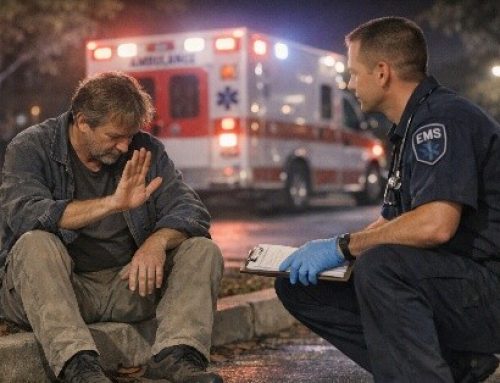
Patients sometimes decline to sign refusal forms. That does not invalidate the encounter, but it requires careful documentation.The narrative should state:
The narrative should state:
- That the refusal was initiated by the patient
- That risks were explained
- That the patient verbalized understanding
- That the patient declined to sign
- What efforts the providers made to convince the patient to sign
- Who was present during the discussion in case that information is in dispute
A simple statement such as “patient refused to sign” is not enough. The record must show that the refusal was informed and voluntary despite the absence of a signature. The record should also show what efforts the providers took to offset the concerns of the patient in an effort to convince the patient to be transported.
Why Signatures Get Missed
In most cases this is not misconduct. It is EMS cognitive overload and cognitive drift.
The patient is impatient. The scene is chaotic. It is late. The crew wants to clear. Someone assumes the other provider obtained the signature.
When missing signatures do not lead to immediate consequences, the shortcut can become normalized. That works until one case ends badly.
There is also the persistent mindset by many EMS providers that a patient refusal is low acuity and not really a call. The belief is, since this is not a call, the same effort does not need to go into assessing the patient or documenting the incident. Since the patient does not want assistance or transport, providers simply need to get a signature so they can “check the box” and move on to other things. This is a dangerous mindset.
The interaction between a provider and the person they are interacting with needs to be thoroughly documented. The document needs to show that the provider did in fact consider the possibility that this person could have a medical or traumatic event even if the person does not recognize it now. The only way to show this is a non-patient, is to assess them thoroughly to rule out any clinical issues and subsequently document that assessment, and discussion, to provide the proof of what was witnessed at the time of the incident. Anything less, exposes the patient to a potential bad outcome and the provider to legal or regulatory risk.

Medical Control and Documentation Discipline
In higher risk refusals, contacting medical control provides an additional layer of protection. A documented consult demonstrates that the risk was recognized and addressed.
In some systems, it is a requirement to obtain a signature from the online medical control physician who was spoken to during the refusal encounter. In other systems it is only required that the providers document who the online control physician was that they spoke with.
Getting the name, or signature if required, of the online physician is an important data element that often gets ignored. It is often deemed a “minor” documentation issue by the documenting provider. Nothing could be more wrong! Documenting that a discussion was had between the provider and online control, or even better, the patient and online control shows the provider made more effort in trying to convince the patient to be seen and that they cared about the patient’s medical condition enough to solicit outside help.
Some providers push back on the need to document online control claiming this requirement is nit picky and does not have any relevance. They also claim that they get push-back from physicians who do not want to be bothered to get on the phone for such “minor” encounters.
Documenting the phone encounter serves several purposes.
- It illustrates that the providers took the time to be thorough in their discussion with the patient regarding the need for transport.
- It gives the online medical control officer the opportunity to try and convince the patient to be seen (patients will sometimes follow the advice of a physician more than other clinical providers).
- It shows the provider solicited another clinical opinion regarding the need for transport (inferring they did not take the situation lightly).
- It may limit some legal risk as the provider is not taking sole responsibility for accepting the refusal.
- It provides another data element (the phone recording if it was recorded) that shows what was discussed with medical control and what actions were agreed upon by medical control, the provider, and the patient.
We often tell providers that if medical control gives them push-back, they should still try to get online control as the protocol often requires it and not calling does not provide them with sufficient defense that they did all they were supposed to do to get the patient to go to the hospital.
If you didn’t call the online physician, you are effectively taking full responsibility for not calling and getting the additional support. It may also lead to accusations that you did not recognize the seriousness of the situation yourself; as any prudent provider would have called for such a concerning patient.
If you call and medical direction gives you a hard time over the phone, that is evidence of the medical control physician not doing their job, not you failing (by not calling) at yours.
Accurate, contemporaneous documentation is not defensive medicine. It is professional practice.
The Bottom Line
A signature alone does not make a refusal defensible.
A missing or questioned signature can significantly weaken it.
And when refusal documentation is incomplete or alleged to be falsified, what might otherwise be analyzed as ordinary negligence can be evaluated as gross negligence.
Accurate documentation and appropriate medical control involvement remain the strongest protections for both the patient and the provider.
The form is not paperwork; it is evidence.
If your organization needs help with patient refusal documentation, contact us for a quote to create a custom program for you.
You can also check out our introductory article on this topic: Patient Refusals: A Risk to an EMS Providers Life, Liberty, and Pursuit of Happiness
Or Part 1 in the series: Incomplete Patient Assessment: The Most Common Risk to the Patient, EMS Provider, and Agency
For more information you can visit the Girard & Associates website at www.girardassoc.com or contact Paul Girard at paul.girard@girardassoc.com or Kevin Kelley at kevinkelleylaw@gmail.com.
About the Authors
Paul Girard, a retired paramedic and EMS Director, is the Founder and President/CEO of Girard & Associates, Inc., a national EMS clinical quality improvement consulting firm. He has worked in EMS continuous quality improvement since the mid-1980s and founded Girard & Associates, Inc. in 2005 to help EMS agencies better monitor, evaluate, and improve the patient care they provide. An EMS CQI entrepreneur, Paul invented and utilizes a proprietary scoring and rating system that drives a teaching, coaching, and mentoring-based CQI process, supporting providers in strengthening clinical judgment, documentation quality, and professional performance. The firm delivers CQI auditing, program development, and CQI program administration for EMS agencies nationwide. Paul is also the co-host of “The G&A Way EMS CQI” podcast.
Kevin J. Kelley, Esq. began his EMS career in 1986. A retired paramedic and EMS Director turned attorney in 2004, Kevin is the founder of Rescuing Rescuers, PLLC, a Massachusetts law firm dedicated to representing firefighters, EMTs, paramedics, and other licensed healthcare professionals. His practice focuses on EMS license regulatory defense, on- and off-duty criminal and self-defense matters, clinical documentation risk assessment, and firehouse EMS-focused education designed to strengthen patient safety, provider decision-making, and professional defensibility before DPH/OEMS, Division of Administrative Law Appeals, and civil and criminal courts. Kevin is also the co-host of “The G&A Way EMS CQI” podcast.